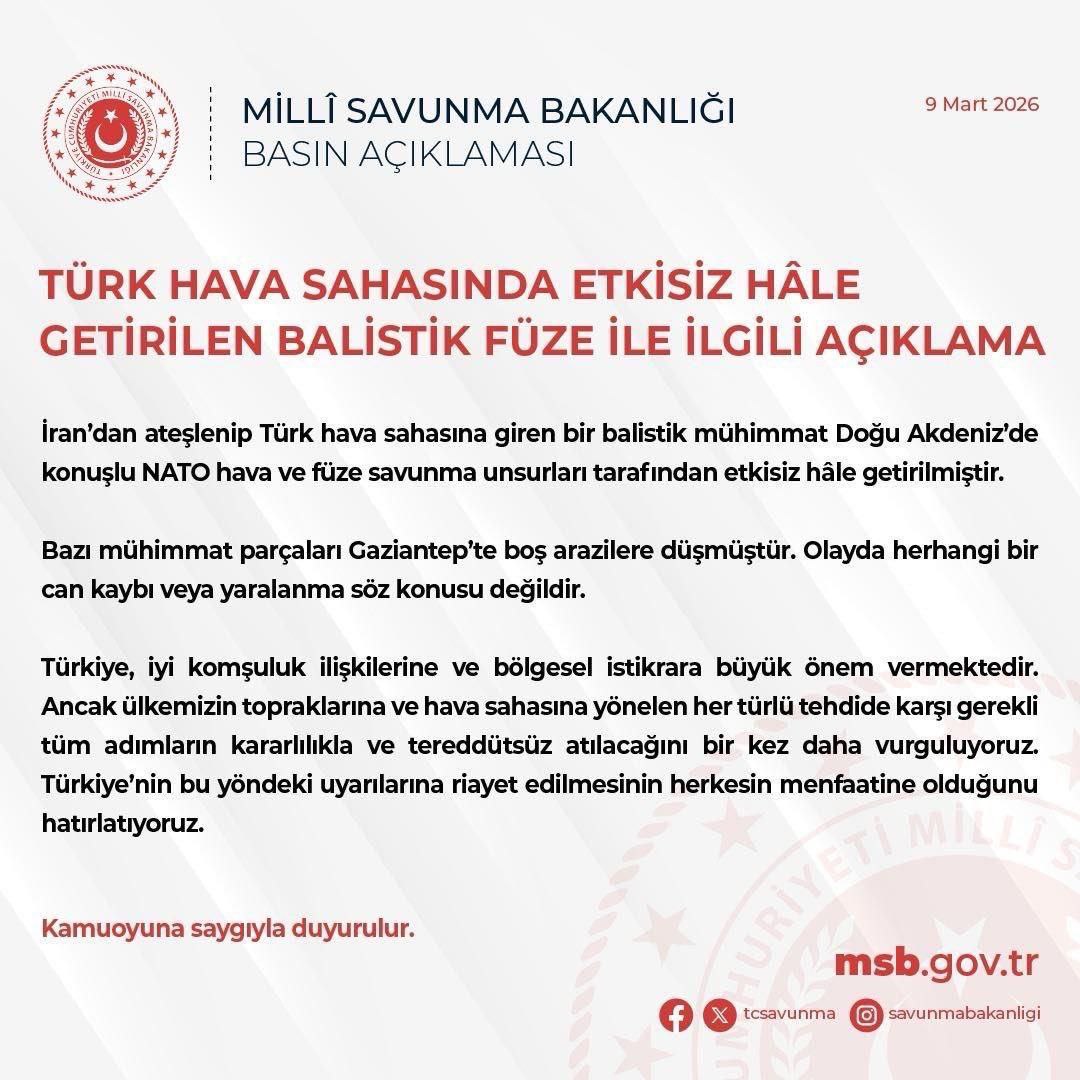
Another Iranian missile enters Turkish airspace, and NATO is suddenly much closer to the blast radius.
Turkey’s Ministry of Defense says another ballistic missile launched from Iran entered Turkish airspace and was intercepted by NATO air defense systems, with debris falling near Gaziantep and no casualties reported. Ankara then summoned the Iranian ambassador for explanations. That is not routine diplomatic housekeeping. It is a warning flare.
The core significance here is geographic and political at the same time. Once a missile crosses into Turkish airspace, this stops being a distant regional exchange and starts touching NATO territory in a direct, physical way. Even if the interception was successful and nobody was killed, the event forces questions about deterrence, rules of response, and whether spillover is becoming normalized.
The debris itself matters too. Reports tied fragments found in Gaziantep to the THAAD interception system, which turns the ground around the impact site into a visible map of just how close this incident came to becoming something worse. The hardware on the ground becomes a form of evidence that the confrontation has moved from abstract warnings into measurable risk.
Turkey is in an awkward position. It has to project control, demand explanations, reassure the public, and avoid being dragged headfirst into escalation dynamics it did not choose. Yet once airspace is crossed, the diplomatic room gets smaller. The state has to show that borders still mean something.
Ex Insider’s read is simple: this is one of those developments that looks containable until it happens three more times. If ballistic traffic into Turkish airspace becomes even semi-regular, the conversation shifts from accidental spillover to an active front edge pressing against NATO’s perimeter.